National Emergency Messaging System
A mission-critical infrastructure for nationwide emergency alerts
Lead Product Designer, End-to-end UX & UI
1 designer, 2 developers, 1 PM
6 Months
Lead Product Designer, End-to-end UX & UI
1 designer, 2 developers, 1 PM
6 Months
Lead Product Designer, End-to-end UX & UI
1 designer, 2 developers, 1 PM
6 Months
TL;DR
Designing systems for confident action under pressure
Impact:
Centralized coordination and workflows, ensuring faster response times and absolute supervisor control during time-critical public safety events
Solution:
A guided, rule-based system built for high-pressure use. Isolated tools unified into a single, observable flow that turns complex operational decisions into clear, sequential steps.
Key takeaway:
In high-pressure environments, design must bridge fragmented processes into a coherent whole to ensure speed, control, and user confidence.
TL;DR
Designing systems for confident action under pressure
Impact:
Centralized coordination and workflows, ensuring faster response times and absolute supervisor control during time-critical public safety events
Solution:
A guided, rule-based system built for high-pressure use. Isolated tools unified into a single, observable flow that turns complex operational decisions into clear, sequential steps.
Key takeaway:
In high-pressure environments, design must bridge fragmented processes into a coherent whole to ensure speed, control, and user confidence.
TL;DR
Designing systems for confident action under pressure
Impact:
Centralized coordination and workflows, ensuring faster response times and absolute supervisor control during time-critical public safety events
Solution:
A guided, rule-based system built for high-pressure use. Isolated tools unified into a single, observable flow that turns complex operational decisions into clear, sequential steps.
Key takeaway:
In high-pressure environments, design must bridge fragmented processes into a coherent whole to ensure speed, control, and user confidence.
CONTEXT
Designing for moments where hesitation is the real risk
This project focused on designing a national emergency alert system for high-pressure situations, where people must act quickly, confidently, and without room for confusion.
That reality defined the core design priorities: clarity, readiness, and trust. Speed and visual innovation were secondary.
CONTEXT
Designing for moments where hesitation is the real risk
This project focused on designing a national emergency alert system for high-pressure situations, where people must act quickly, confidently, and without room for confusion.
That reality defined the core design priorities: clarity, readiness, and trust. Speed and visual innovation were secondary.
CONTEXT
Designing for moments where hesitation is the real risk
This project focused on designing a national emergency alert system for high-pressure situations, where people must act quickly, confidently, and without room for confusion.
That reality defined the core design priorities: clarity, readiness, and trust. Speed and visual innovation were secondary.
Before designing, we aligned on what truly mattered:
STRATEGY & FOUNDATIONS
Building trust under pressure
The
Challenge
Transforming fragmented emergency workflows into a reliable system that reduces human error and enables confident action under pressure.
The
Challenge
Transforming fragmented emergency workflows into a reliable system that reduces human error and enables confident action under pressure.
The
Challnge
Transforming fragmented emergency workflows into a reliable system that reduces human error and enables confident action under pressure.
How we
Worked
Working closely with product, operations, and development, we aligned terminology, approvals, and escalation flows to support decision-making under pressure.
How we
Worked
Working closely with product, operations, and development, we aligned terminology, approvals, and escalation flows to support decision-making under pressure.
How we
Worked
Working closely with product, operations, and development, we aligned terminology, approvals, and escalation flows to support decision-making under pressure.
Design
Principles
Design
Principles
Design
Principles
USERS & PAIN POINTS
Two user groups. One shared risk.
The platform served two primary user groups operating under extreme time pressure. Despite different roles, both depended on clarity, speed, and trust.


Operational Users
Operators
I need to act fast without second-guessing the system.
The system had to guide correct actions by default and minimize cognitive load.

Operational Users
Operators
I need to act fast without second-guessing the system.
The system had to guide correct actions by default and minimize cognitive load.

Operational Users
Operators
I need to act fast without second-guessing the system.
The system had to guide correct actions by default and minimize cognitive load.

Supervisors & Approvers
I need full visibility and confidence before anything goes live.
They needed predictable approval logic, clear accountability, and real-time oversight.

Supervisors & Approvers
I need full visibility and confidence before anything goes live.
They needed predictable approval logic, clear accountability, and real-time oversight.

Supervisors & Approvers
I need full visibility and confidence before anything goes live.
They needed predictable approval logic, clear accountability, and real-time oversight.
THE PROBLEM
Where things break under pressure
Existing emergency messaging workflows were never designed as one coherent system.
Under pressure, fragmentation turned into risk.
Existing emergency messaging workflows were never designed as one coherent system. Under pressure, fragmentation turned into risk.
Failure points in existing workflows
Isolated systems failed to support the speed, control, and confidence required in time-critical public safety events.
SOLUTION ARCHITECTURE
Designing for decisive action
The system was redesigned around a single principle:
Operators should never have to think twice under pressure.
A guided, rule-based campaign flow turns complex decisions into clear, sequential steps, while giving supervisors continuous visibility and control.
One campaign. Clear stages. Shared context.
Instead of fragmented tools and ad-hoc steps, alerts are managed through a single campaign model.
Each stage resolves one decision domain, from targeting to delivery, while maintaining shared context end to end.
Campaign
Targeting
Content
Timing
Approval
If required
Distribution
Monitoring
Managers review intent & content
Campaigns are executed
with real-time visibility and control
Delivery logic
Live oversight
Campaign
Targeting
Content
Timing
Approval
If required
Distribution
Monitoring
Managers review intent & content
Campaigns are executed
with real-time visibility and control
Delivery logic
Live oversight
Clear steps. Shared visibility.
How the campaign model works
A stage-based flow guides alert creation under pressure.
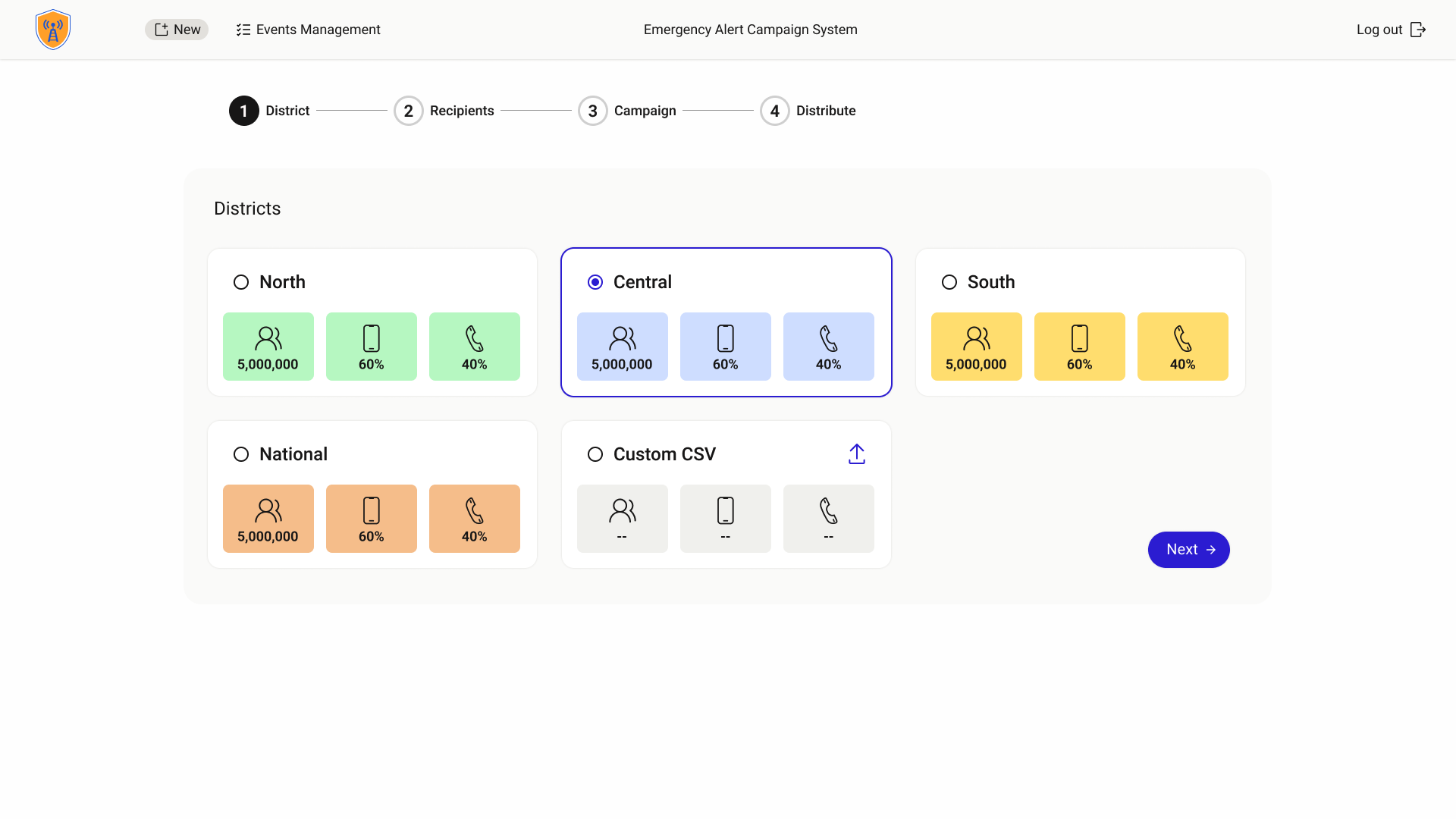
01
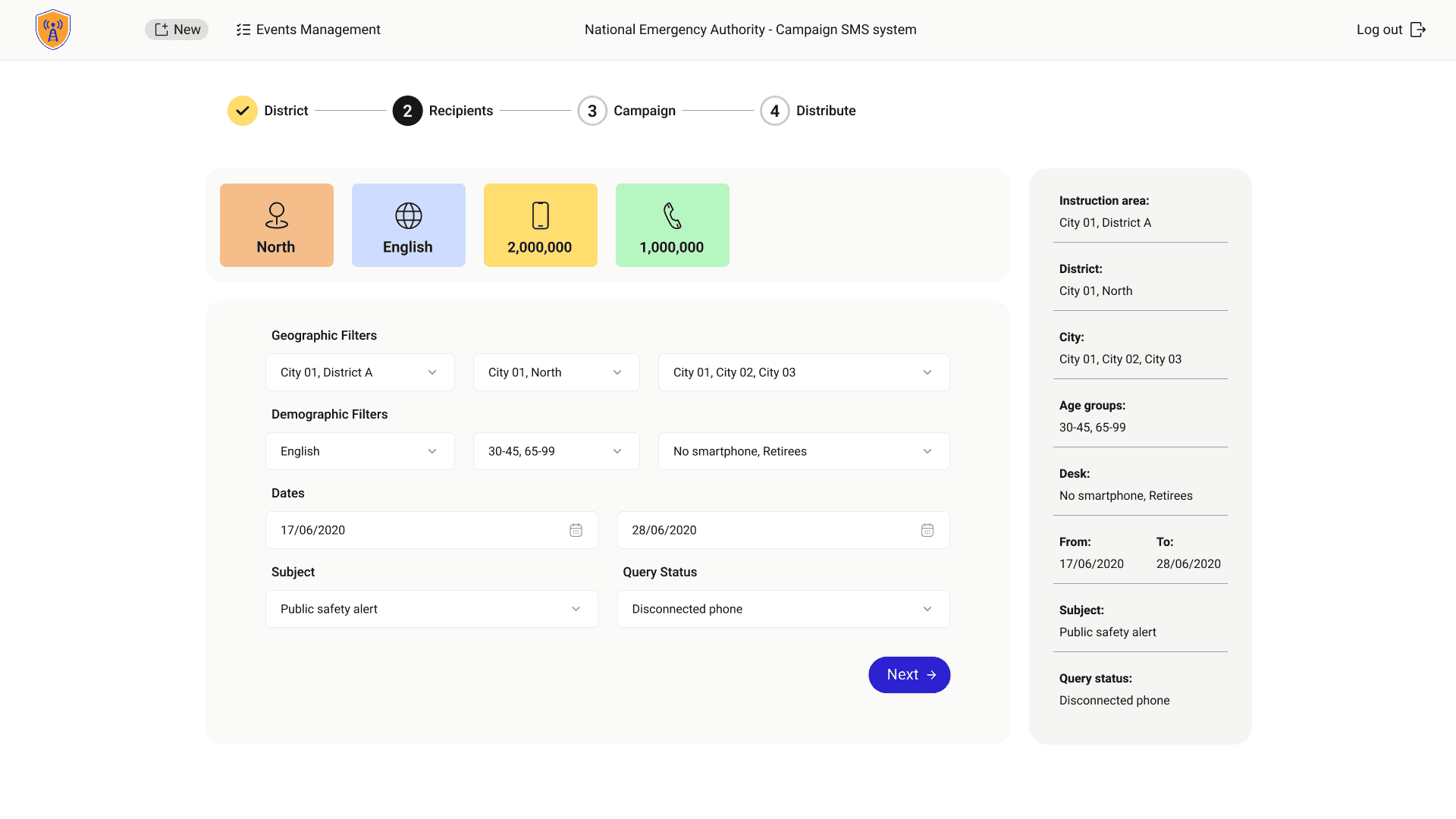
Audience source: district or CSV list
Campaigns start by defining the audience via district selection or a predefined CSV list.
Reach is set upfront, preventing last-minute mistakes.

01
Audience source: district or CSV list
Campaigns start by defining the audience via district selection or a predefined CSV list.

Reach is set upfront, preventing last-minute mistakes.
01
Audience source: district or CSV list
Campaigns start by defining the audience via district selection or a predefined CSV list.

Reach is set upfront, preventing last-minute mistakes.
02
Refine recipients
Refine the audience using demographic filters.
This reduces ambiguity and ensures messages reach the right recipients.

02
Refine recipients
Refine the audience using demographic filters.

This reduces ambiguity and ensures messages reach the right recipients.
02
Refine recipients
Refine the audience using demographic filters.

This reduces ambiguity and ensures messages reach the right recipients.
03
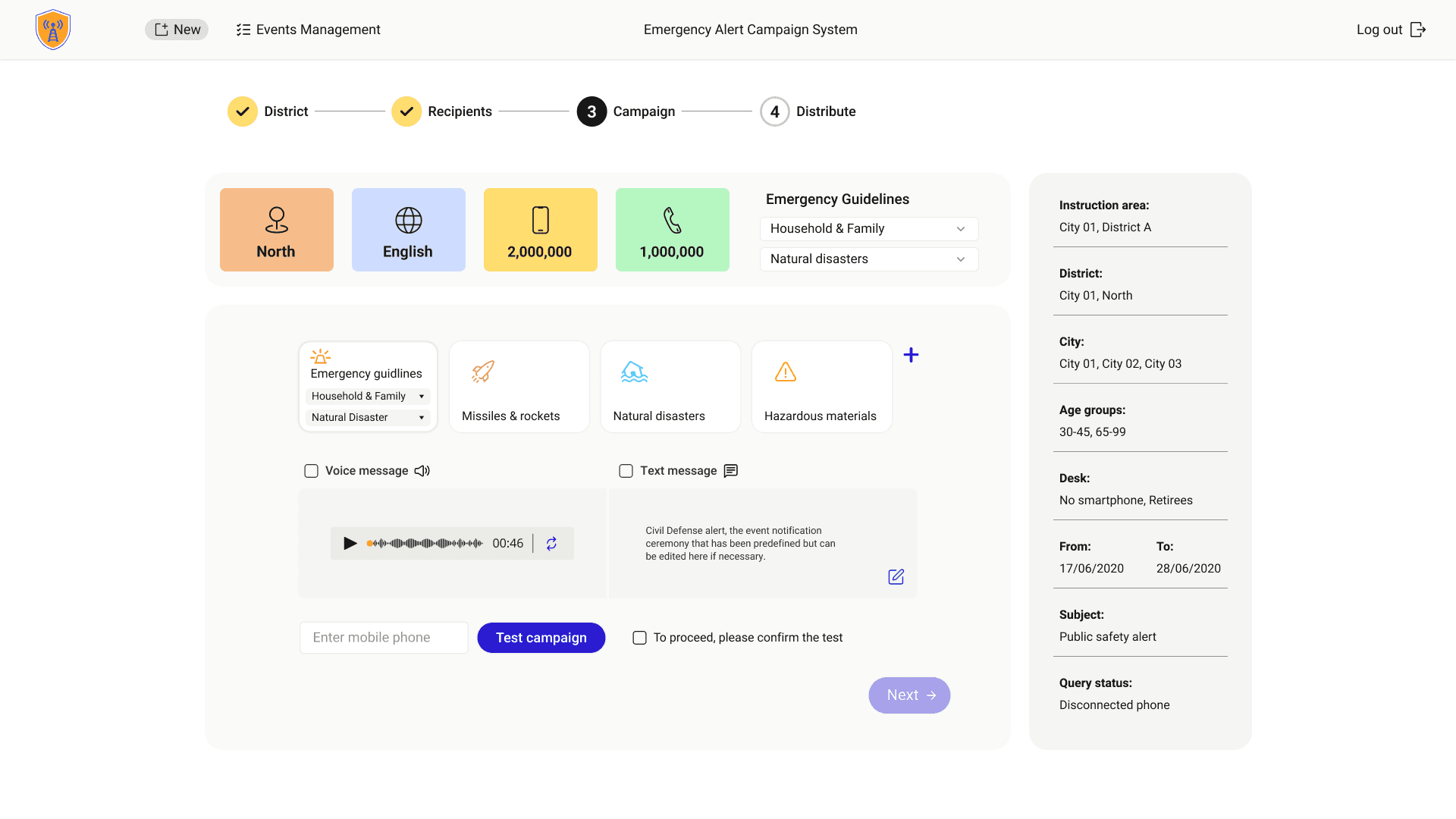
Select and validate campaign content
Content is selected from a structured library, organized by subject and subcategories.
Each campaign is tested on a real device and explicitly confirmed before delivery.

03
Select and validate campaign content
Content is selected from a structured library, organized by subject and subcategories.

Each campaign is tested on a real device and explicitly confirmed before delivery.
03
Select and validate campaign content
Content is selected from a structured library, organized by subject and subcategories.

Each campaign is tested on a real device and explicitly confirmed before delivery.
04
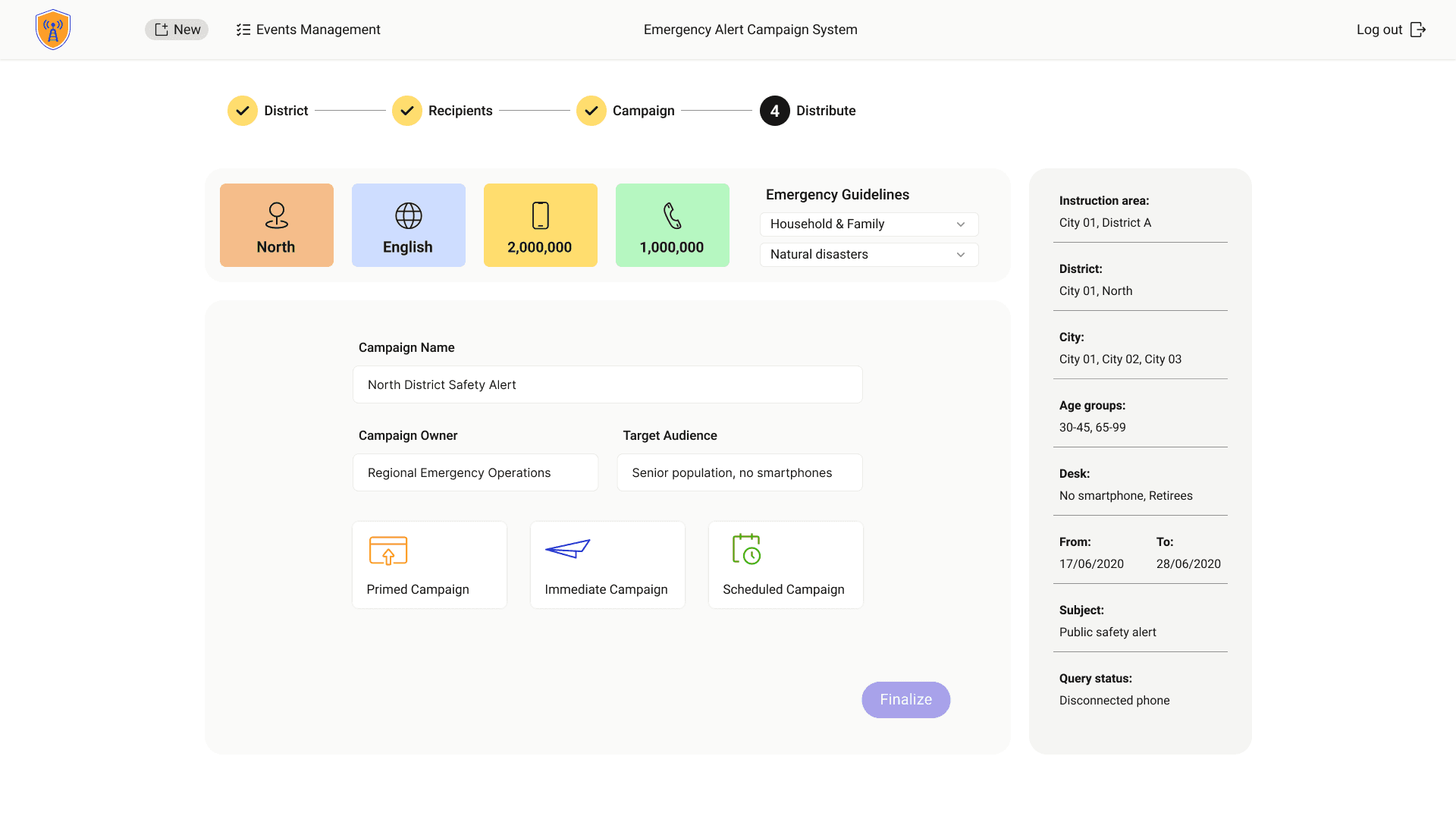
Set delivery logic and timing
Delivery logic is defined upfront: immediate, scheduled, or prepared in advance.
New or modified content enters approval by default, ensuring only validated messages go live.

04
Set delivery logic and timing
Delivery logic is defined upfront: immediate, scheduled, or prepared in advance.

New or modified content enters approval by default, ensuring only validated messages go live.
04
Set delivery logic and timing
Delivery logic is defined upfront: immediate, scheduled, or prepared in advance.

New or modified content enters approval by default, ensuring only validated messages go live.
05
Operational oversight
Once a campaign goes live, managers gain real-time visibility and control.

05
Operational oversight
Once a campaign goes live, managers gain real-time visibility and control.

05
Operational oversight
Once a campaign goes live, managers gain real-time visibility and control.

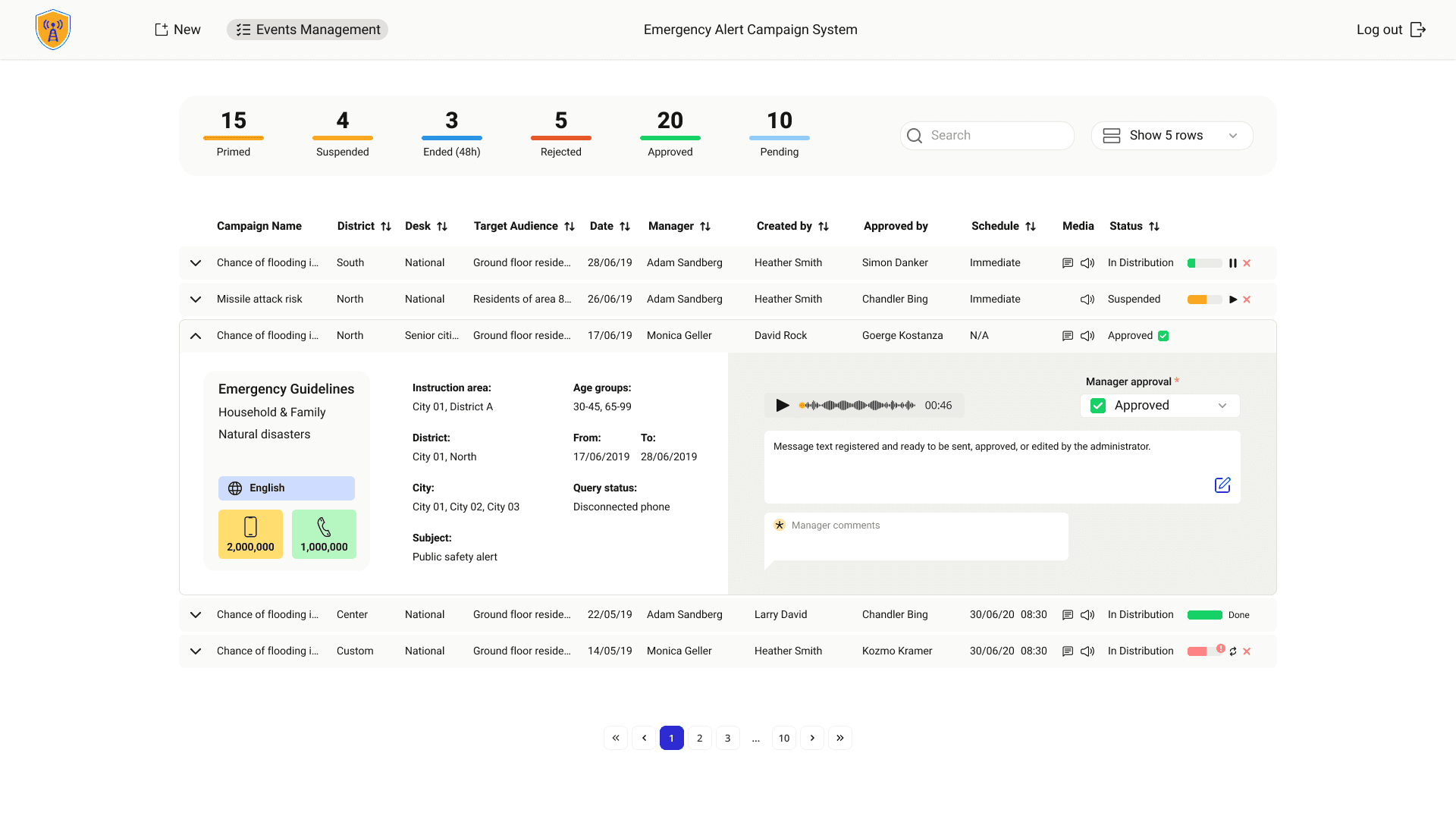
IMPACT
From emergency tools to real-time control
The new campaign system replaced manual coordination with a single, observable flow built for high-pressure use.
Tested under high-volume, time-critical conditions
Used in live public-safety operations
Deployed across regions in real scenarios
Proven in The Field
Tested under high-volume, time-critical conditions
Used in live public-safety operations
Deployed across regions in real scenarios
Proven in The Field
Tested under high-volume, time-critical conditions
Used in live public-safety operations
Deployed across regions in real scenarios
Proven in The Field
Decisions supported under time pressure
Guided, stage-based flow enforces correctness
Errors prevented by design, not process
Built for Critical Use
Decisions supported under time pressure
Guided, stage-based flow enforces correctness
Errors prevented by design, not process
Built for Critical Use
Decisions supported under time pressure
Guided, stage-based flow enforces correctness
Errors prevented by design, not process
Built for Critical Use
Live visibility across all campaigns
Content and delivery handled in one context
Immediate pause or stop when conditions change
Live View
Live visibility across all campaigns
Content and delivery handled in one context
Immediate pause or stop when conditions change
Live View
Live visibility across all campaigns
Content and delivery handled in one context
Immediate pause or stop when conditions change
Live View
Clear states across approval and delivery
One dashboard for status, ownership
Faster decisions without cross-team handoffs
Single Source of Truth
Clear states across approval and delivery
One dashboard for status, ownership
Faster decisions without cross-team handoffs
Single Source of Truth
Clear states across approval and delivery
One dashboard for status, ownership
Faster decisions without cross-team handoffs
Single Source of Truth
DESIGN TRADEOFFS & LEARNINGS
01
Designing For Real-World Operations
This project reinforced the need to design systems around how decisions are actually made under pressure. Clarity and readiness mattered more than flexibility.
02
Visibility Enables Control
In high-risk systems, trust comes from shared visibility. Clear oversight enables fast, confident action when there’s no room for doubt.
Designing for pressure means prioritizing clarity, shared context, and human performance when it matters most.
DESIGN TRADEOFFS & LEARNINGS
01
Designing For Real-World Operations
This project reinforced the need to design systems around how decisions are actually made under pressure. Clarity and readiness mattered more than flexibility.
02
Visibility Enables Control Under Pressure
In high-risk systems, trust is built through visibility, not restriction.
Clear oversight and validated flows enable fast, confident action in critical moments, without introducing hesitation or risk.
Designing for pressure means prioritizing clarity, shared context, and human performance when it matters most.
DESIGN TRADEOFFS & LEARNINGS
01
Designing For Real-World Operations
This project reinforced the need to design systems around how decisions are actually made under pressure. Clarity and readiness mattered more than flexibility.
02
Visibility Enables Control
In high-risk systems, trust comes from shared visibility. Clear oversight enables fast, confident action when there’s no room for doubt.
Designing for pressure means prioritizing clarity, shared context, and human performance when it matters most.
Next Project
Next Project
Next Project
EdTech Learning Player
From a legacy player to a responsive, interactive learning experience.

EdTech Learning Player
From a legacy player to a responsive, interactive learning experience.

EdTech Learning Player
From a legacy player to a responsive, interactive learning experience.